What an EPA adds.
Entrustable Professional Activities, or EPAs, describe observable units of clinical work. An entrustment assessment asks what supervision a trainee needs for a defined activity, bringing knowledge, technical skills, judgement and professional behaviours into clinical context. Repeated observations across cases and assessors can inform an educational review. [1] [2]
In Opus, feedback is linked to a shared case and an eligible procedure where the learner was primary surgeon. Assisting is recorded as exposure rather than an entrustment rating. This is not a complete official EPA curriculum.
Paired assessment, with independent initial ratings.
- Record each perspective. The learner reflects on the case; the supervisor records the supervision needed and their observations. Participants know one another’s identities.
- Submit your rating first. Normally, each participant submits their rating before seeing the other's. Once both have responded, the paired feedback can become available.
- Review what became available. Compare both perspectives, the narrative and the case context. A difference is a useful discussion point; it does not determine who is right. [5]
Private reflective notes are not shared. Teaching feedback becomes available through the assessment workflow. The workflow does not prevent clinical discussion between participants, and no proven reduction in bias is claimed.
Read the record, not just the score.
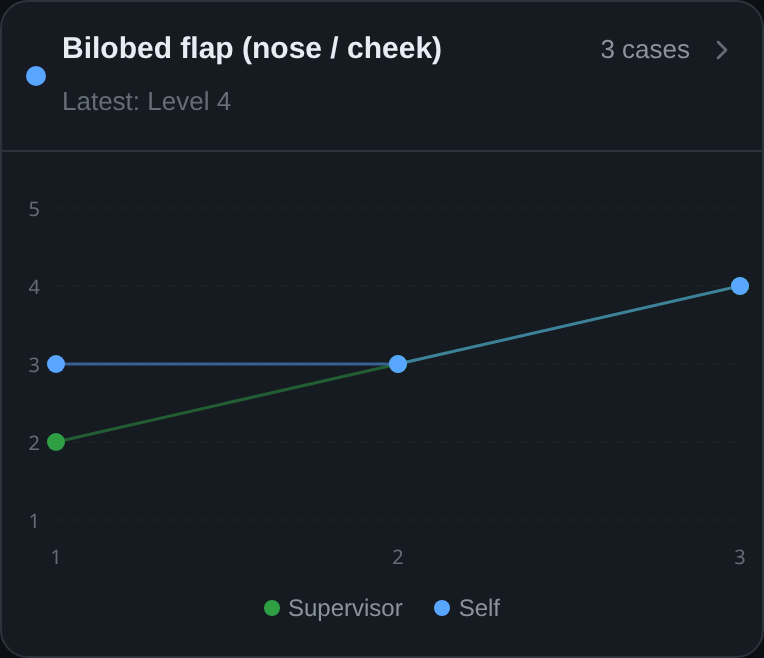
Opus uses five entrustment anchors, from “I had to do it” through increasing independence to “I did not need to be there”. These are ordered categories: four does not mean twice the competence of two. Published instruments can use different anchors or numbers of levels. [2]
Look across cases, assessors, complexity, missing observations and narrative feedback. The Practice view counts your own performed cases; Training summarises available completed pairs. Learning curves use assessment reveal dates, not operation dates.
Calibration needs at least three full pairs and describes absolute differences between ordinal scores. Its in-app quality labels are unvalidated. Teaching summaries need five full assessments and three distinct shared cases , not three distinct trainees; older and current teaching scales have different anchors and may be pooled.
Multicentre surgery studies support particular educational uses of repeated EPA observations. They do not validate Opus, its scale, rating-sharing workflow or statistical summaries. Committee confidence is also not the same as accuracy. [3] [4]
For mentors: what are you confirming?
Three records serve different purposes. Keeping them separate makes the discussion and any later report easier to interpret.
Involvement confirmation
A tagged colleague can verify or dispute their involvement in the shared case. This is an attributable account, not independent proof of attendance.
Role and supervision attestation
An eligible senior colleague can attest the recorded role and supervision per procedure. This confirms fields in the record; it is not certification.
Formative assessment
Paired feedback brings the learner’s and supervisor’s perspectives into a training conversation. Progression decisions stay with the programme.
See the case-sharing workflow or contact Opus with a mentor question. Sharing sends encrypted identifiable clinical information to the selected care-team colleague. New sharing is paused in Germany and Switzerland, limiting paired assessments there.
Primary scientific references
The rationale, and its limits.
This is a targeted evidence guide, not a systematic review. References support educational concepts and specific studied uses. None evaluates or validates Opus itself.
- Ten Cate O. A primer on entrustable professional activities. Korean J Med Educ. 2018;30(1):1–10.
Relevance: Explains clinical activities, supervision and the place of repeated observations in an educational programme.
Limit: Conceptual guidance; not a trial of educational effectiveness or an evaluation of Opus.
- Ten Cate O, Schwartz A, Chen HC. Assessing Trainees and Making Entrustment Decisions: On the Nature and Use of Entrustment-Supervision Scales. Acad Med. 2020;95(11):1662–1669.
Relevance: Distinguishes supervision provided from entrustment for future work, and daily observations from summative decisions. Scores are ordinal categories.
Limit: Does not establish a universal scale, validate Opus’s five anchors or confer certification.
- Montgomery KB, Mellinger JD, Jones A, et al. Validity of Entrustable Professional Activities in a National Sample of General Surgery Residency Programs. J Am Coll Surg. 2024;238(4):376–384.
Relevance: In a multicentre general-surgery pilot, summative EPA ratings correlated with mapped Milestones.
Limit: Evidence concerns the studied programmes and use. It does not validate Opus or show improved patient outcomes or a benefit from rating concealment.
- Montgomery KB, Mellinger JD, McLeod MC, et al. Decision-Making Confidence of Clinical Competency Committees for Entrustable Professional Activities. JAMA Surg. 2024;159(7):801–808.
Relevance: More microassessments were associated with higher committee confidence in most EPA phases.
Limit: An observational association. Confidence is not the same as accuracy; this does not establish causation or assess Opus.
- Kendrick DE, Clark MJ, Fischer I, et al. The reliability of resident self-evaluation of operative performance. Am J Surg. 2021;222(2):341–346.
Relevance: Resident and faculty perspectives frequently differed, making their comparison relevant to a feedback conversation.
Limit: Disagreement does not identify who is right. This study does not test the benefit of concealing ratings or validate Opus’s workflow.
- ten Cate O. Entrustability of professional activities and competency-based training. Med Educ. 2005;39(12):1176–1177.
Relevance: An early conceptual reference for entrustable professional activities.
Limit: Historical attribution only here. PubMed has no abstract; the 2018 primer supports the substantive explanation above.
Metadata and supporting abstracts checked against PubMed on 18 October 2026; the 2018 primer’s full text was also checked. The 2005 item is included for historical attribution only.
Continue the conversation.
Explore the actual case workflow, or review data handling and reporting boundaries with the people responsible for your training programme.